Steam friend invites
Invite a friend from Steam's own overlay. Connections go straight between you when Steam finds a route and are relayed through Steam otherwise, so there is no Hamachi and no port forwarding. Direct IP still works too.
BeaverBuddies Stability Fork lets you and your friends run one Timberborn colony at the same time, with Steam friend invites, a live connection panel, and fixes for the crashes and desyncs that make multiplayer painful.
Free and open source. Tested on Windows with the Steam version of Timberborn 1.1.2.4.
No router settings, no virtual networks. If you both have Timberborn on Steam, you are a few clicks away.
Same download, same version, then restart the game. Install guide
Load a save, choose Host co-op game, then Invite Friends and pick your friend in Steam's overlay.
When your friend appears in the player list, the host chooses Start Game. Everyone builds in the same colony.
Everything the original BeaverBuddies does, plus the parts that make a long co-op session actually work.
Invite a friend from Steam's own overlay. Connections go straight between you when Steam finds a route and are relayed through Steam otherwise, so there is no Hamachi and no port forwarding. Direct IP still works too.
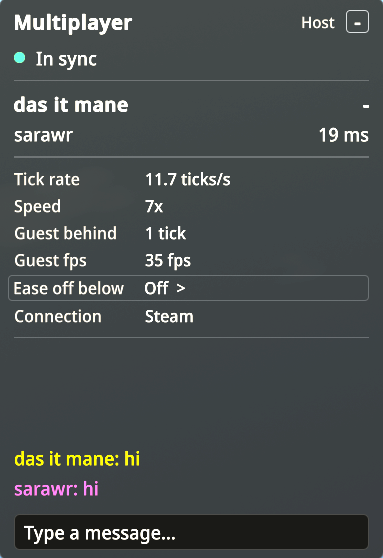
See who is connected, each player's ping, whether you are in sync, and the tick rate at a glance, and chat with everyone in the game. Collapse it to one line or hide it completely.
Colored, translucent cursors with names, selection outlines, and Viewing / Editing labels on buildings. Restyle each player's cursor in the Player cursors dialog.
Fixes for the water, animation, random-number, saving, demolition and input problems that knocked sessions out of sync or crashed them.
Joining with a different build is refused before the save is sent, and a warning lists any mods that differ. Failed connections and multiplayer actions end with a plain-language reason instead of a silent hang.
A guest's actions reach the host about half a tick sooner (roughly 0.3 seconds at normal speed), the mod does less work every tick and every frame, and over Steam the ping no longer climbs as the game speeds up.
Choose Invite Friends and your friend gets a normal Steam invitation. If their game is closed, Steam launches it and joins for them.
Confirmed Working in real playtests between the maintainer and a friend.
Both players need to be online in Steam and to own Timberborn on Steam.
A small panel in a corner of your screen during multiplayer games. It only reads: it sends no gameplay events, and if it ever fails it switches itself off.
| Status | What it means |
|---|---|
| In sync | Normal. Everything is running together. |
| Catching up | Guests only: your game is a few ticks behind the host. |
| Waiting for host | Guests only: nothing has arrived from the host for a moment. |
| Connection unstable | Someone has stopped responding for five seconds. |
| Out of sync | A desync was detected. |
| Disconnected | The session has ended. |
Ping is measured by the mod's network layer, so it means the same thing over Steam, Hamachi and direct IP. Over Steam it includes a short wait for each game to serve Steam, which the mod keeps to a few milliseconds even at a high game speed.
Other players' cursors, selections and building edits show up on your screen, so you stop building on top of each other.
Open Options (Esc) and choose Player cursors. Each connected player gets a card:
| Control | Range | Default |
|---|---|---|
| Color | Their color, 10 presets, or exact RGB | Their color |
| Size | 50% to 300% | 100% |
| Transparency | 0% to 90% | 50% |
These are display-only choices that stay on your machine. They are never sent to other players, are remembered by player name, and cannot affect the simulation.
Each fix is marked by how well it is confirmed. Confirmed means it was verified in a real multiplayer playtest; Tested means automated regression checks cover it but it has not been confirmed in a live session.
Players at different frame rates used to see different water, which caused desyncs. The water now follows the simulation's own clock. It resolved a reported "badtide" desync.
A path cursor that could move backward between ticks, and non-finite visual coordinates, no longer crash the game.
The original only warned about a version mismatch after the save had loaded. The fork compares the game version and the exact mod build first, with a time limit and a clear message.
If a multiplayer action fails, replay stops, the session pauses and peers are told, instead of two games quietly drifting apart.
Nested random-number scopes are restored even after errors, a stale saving flag is cleared, and water sources are applied in a consistent order.
A replayed demolition selection that included already-demolished buildings no longer ends the session, equal-distance demolition jobs are chosen deterministically, and input state is recovered after a desync, a failed action or a lost connection, so the menu and controls keep working. The maintainer confirmed the controls work after a disconnect; the other cases are covered by checks only.
Over Steam, data used to wait for the end of every frame, and at a high game speed a frame is mostly simulation, so the ping grew with the speed. Steam is now also served between the ticks of a frame. At a true speed 7 the ping stayed under 100 ms, where it had been 200 to 300 ms.
The host picks a frame rate floor; while a guest stays below it, the host slows the game a little and speeds back up by itself. It never changes what happens in a tick. An earlier version of the rule was played once and worked but changed speed too often; the current rule has not been played yet.
The full list is in the changelog.
Timberborn is a single-player game, so BeaverBuddies keeps every player's copy of the game identical instead of streaming one game to everyone.
That is why everyone must run the same build, why other mods should match, and why nobody can join once the host has started. When something breaks that sameness, that is a desync. The original project's wiki explains the design in more detail.
More answers are in the FAQ, and Troubleshooting covers what to do when something goes wrong.
Download the mod, follow the install guide, and send your friend an invite.